
Designed in collaboration with the Cambridge Institute for Sustainability Leadership, this two-day SusEd Summit 2.0 will bring together students, teachers and leaders from national and international systems of education with policymakers, leaders in business, industry, artists, and climate experts. The summit is not just a destination – it’s the catalyst for a year-long journey of systemic change.
Together, we will embark a sustainability journey designed to inspire systemic change by connecting initiatives in sustainability & education across Europe. We will develop cross-sector partnerships and commit to imagining and implementing measurable and meaningful systemic change in schools and organisations. Woven through the summit will be the connected themes of Youth Agency, Regenerative Economics & Leadership and Active Hope, as we confront the systems failures that have led us to the current climate emergency and commit to helping to forge a better, more peaceful and more sustainable future.
Our Focus
The two-day summit will follow Otto Scharmer’s “Theory U” and through a series of carefully choreographed, intense engagements, facilitated reflection and planning workshops, we will work collaboratively to investigate the summit themes, Youth Agency, Regenerative Economics & Leadership and Active Hope and embrace the imperative of education and leadership to shape a pathway to a better, more peaceful and sustainable future.
CONCEPTUAL UNDERSTANDINGS
Systemic change – requires sustained collaboration, not isolated events.
The Summit – is the catalyst for a nine-month Sustainability Accelerator, beyond a standalone experience.
Sustained innovation – evolves through experimentation, reflection, coaching and iteration.
Diverse partnerships – strengthen collective capacity to address complex sustainability challenges.
Schools transform – through conscious reimagining the Where, What and How of education.
Students – are co-designers and leaders of meaningful change.
Shared learning – accelerates innovation across schools, organisations and countries.
Measurable impact – emerges through implementation, evaluation and continuous improvement.
OBJECTIVES
Develop a shared vision - for sustainable transformation within their school or organisation.
Design – a practical innovation project during the Project Genesis Summit.
Build – cross-sector partnerships supporting long-term collaborative action.
Participate – in five Accelerator workshops from October to June.
Apply learning – through implementation between each Accelerator phase.
Access coaching and peer support - throughout the innovation journey.
Test, refine and scale – solutions using evidence and feedback.
Showcase – measurable outcomes and next steps in June.
Join – a growing European network advancing sustainability through education.
Be equipped – to lead meaningful, measurable systemic change.
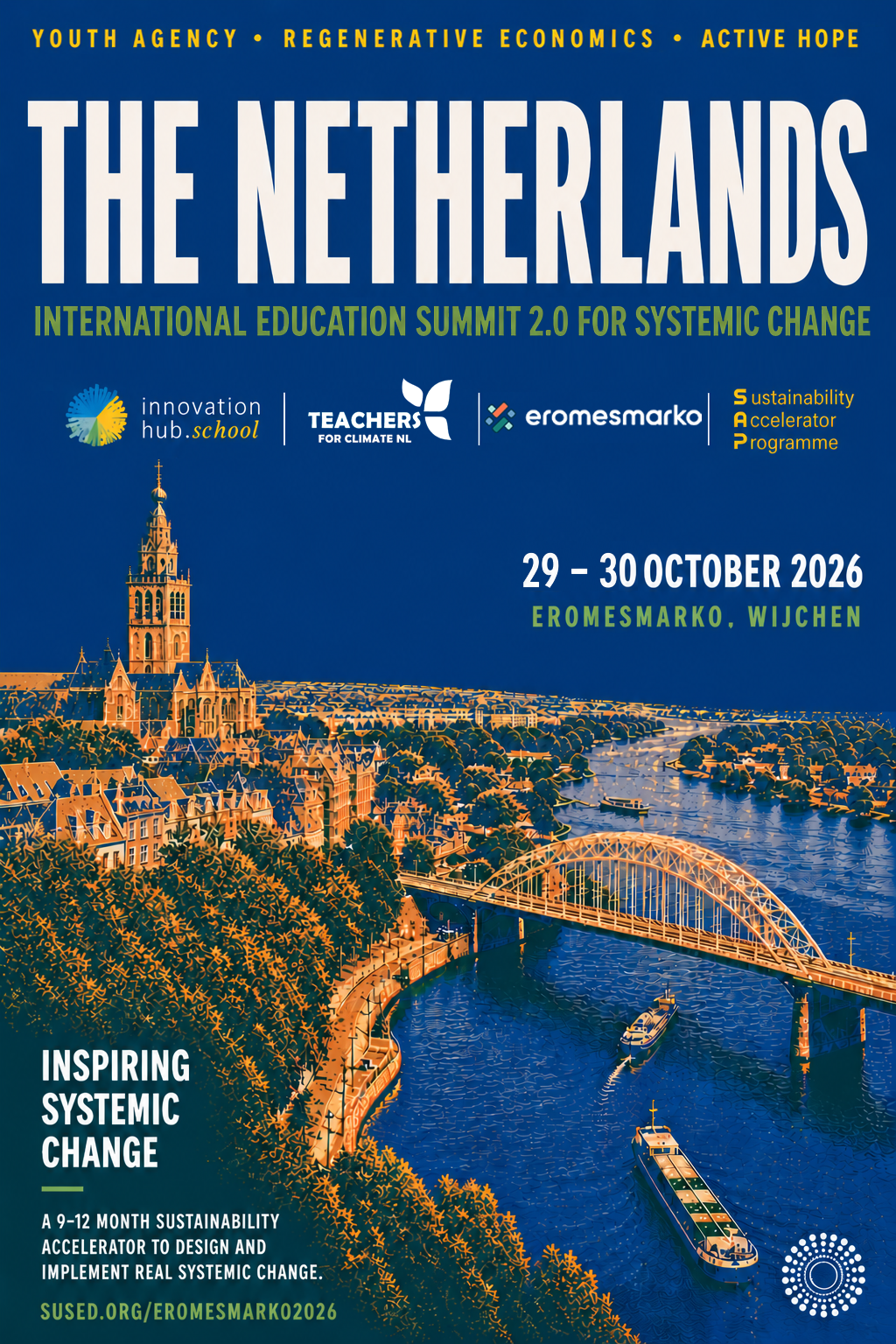
International Education Summit 2.0 for Systemic Change,
October 29–30: part of the Sustainability Journey
Day 1: The challenges we face
Day 2: Meeting the challenge
Outcomes
Led by Teachers for Climate, Innovationhub.school, Eromesmarko, and SusEd, the initiative focuses on:
Sustainability & regenerative economics & leadership
Youth agency & active hope
Cross-sector collaboration
Practical, measurable systemic change
The summit itself follows a “Project Genesis” phase, a collaborative space where participants will define visions for change, identify key challenges, build partnerships, and design actionable next steps for their own communities. The summit is the catalyst and the connector.
The journey:
Over 9–12 months, participating teams will engage in a structured Sustainability Accelerator programme including:
Collaborative workshops (online and in-person)
Peer learning and coaching
Innovation initiatives
Shared practice across European schools
Real-world implementation and refinement of sustainability initiatives
Our aim is to nurture sustained action and measurable impact.
At the heart of the journey is a shared commitment to empowering young people as active planetary citizens and reimagining education through a whole-school approach, from curriculum and pedagogy to culture, infrastructure, and leadership.
Registration & Payment Terms
We have reserved places for representatives from up to 15 schools and universities across Europe. Each school is encouraged to send five participants, typically including the Principal, Bursar/Operations Manager (or equivalent), a ‘champion teacher,’ and two students from Grade 10 or above. However, we recognise that we will need to be flexible in accommodating as broad and diverse a demographic as possible, so please be encouraged to explore a different shape to your delegation as your context dictates.
Summit Registration Fees & Payment Terms
Delegation Package (3 x Adults & 2 x Students): €1500
Individual Delegate (Adult): €495
Student Delegate (must be accompanied by at least 1 adult delegate): FREE
Sustainability Accelerator Programme (SAP) Post-summit
Group fee: €2500 per school
Individual coaching fee: €4500 per school
Please click on the link above to express your interest in attending. Please note that we expect this summit to be oversubscribed.
Getting to Wijchen
Wijchen is located in the east of the Netherlands, next to the city of Nijmegen, and is easy to reach by air, rail, and road. Eromesmarko is at Nieuweweg 240, 6603 BV Wijchen.
By Air
The most convenient airports are:
Amsterdam Schiphol (AMS) – the main international gateway, with direct rail connections to Nijmegen/Wijchen.
Eindhoven Airport (EIN) – popular for European low-cost carriers and less than an hour from Wijchen by road.
Düsseldorf Airport (DUS) and Weeze Airport (NRN) in Germany are also practical options for international travellers.
By Train
Wijchen has its own railway station on the Dutch national rail network, with regular services via nearby Nijmegen, one of the Netherlands' main rail hubs.
From Amsterdam Schiphol Airport, direct trains run to Nijmegen approximately every hour, taking around 1 hour 30 minutes; from Nijmegen it is a short onward journey to Wijchen.
By Road
Wijchen is well connected to the Dutch motorway network and is approximately:
15 minutes from Nijmegen
1 hour from Eindhoven Airport
1½ hours from Amsterdam Schiphol Airport (traffic permitting)
For rail planning, attendees can use the Dutch Railways (NS) journey planner.
Travel Tip: For most international visitors, flying into Amsterdam Schiphol and continuing by train is usually the simplest and most sustainable option